GAME RECOGNIZE GAME
a review of a Neo-Decadent book on electronic games and the occult

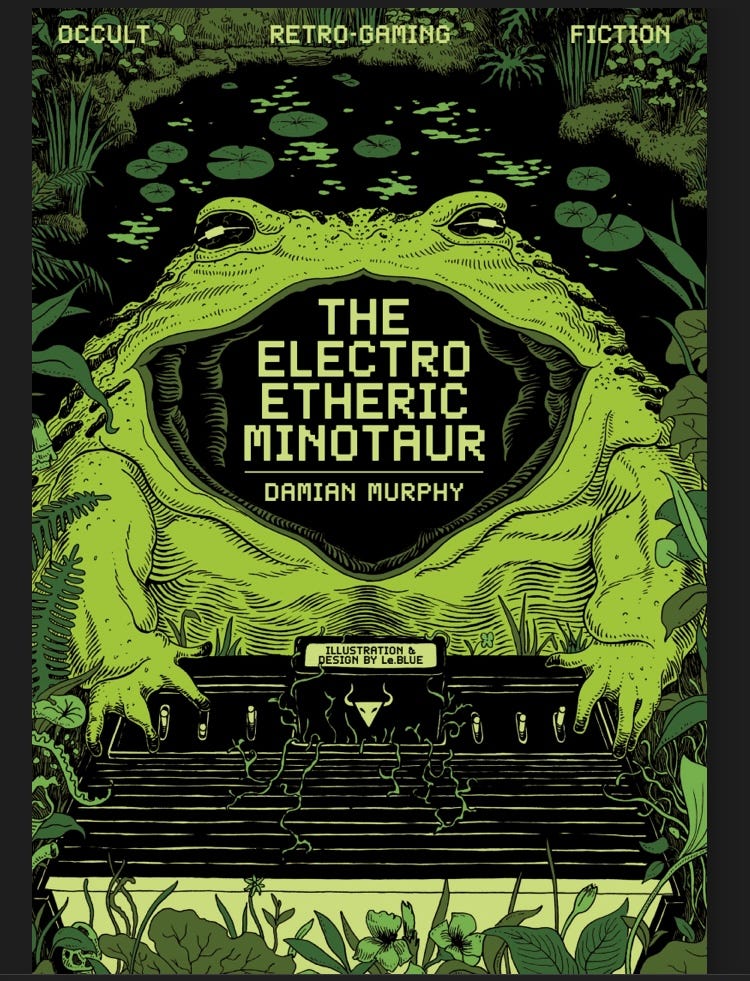
GAME RECOGNIZE GAME
a review of The Electro-Etheric Minotaur by Damian Murphy (Church Ghost, 2026)
Here is a link to the publisher to purchase the book:
https://www.churchghost.com/product-page/the-electro-etheric-minotaur
For several years the ringtone on my Android which signified that a text had come in was the Secret Sound from the Legend of Zelda, the mysterious 8-note tune that played in the game whenever you revealed a secret passageway or solved a puzzle. Nintendo lore has it that, even more than writing the game’s main “Overworld” theme, sound designer Koji Kondo struggled to develop the right sound effect in the game universe to signal a deep mystery being satisfactorily resolved.
I got out of the habit of playing video games and computer games with any regularity when I entered teenage years, although I acknowledged their fascination and power and could see these cultural artifacts taking up a central position in imaginations formerly reserved for books and music. The word Gesamtkunstwerk is thrown around a lot: a “total artwork” that marries narrative, decoration, music, all other artworks into it. At one time opera was thought to be a total artwork, and cinema seems be making the strongest case currently, but Damian Murphy’s new fiction collection The Electro-Etheric Minotaur (Church Ghost, 2026) presents video games, in particular rare, limited edition games from the primitive early days of video games—“retro-gaming”—as arcane documents with hidden spiritual value, pathways into occult knowledge. This new artwork carries with it interactivity, player choices, unlocking concealed areas and learning new skills, which Murphy fictionalizes into greater metaphors and analogies to occult “teachings.”
The stories of the collection often posit a shadowy game creator from the early 1980s designing an electronic game-world that manages to operate like an esoteric puzzle. The near-historical timeline is important; Murphy’s seekers and adventurers (and victims) are digging into a dusty, archaic past: the dawn of the electronic age we currently live in. Video games, which according to Neo-Decadent manifestos may “aspire to the condition of poetry,” are the lost historical interface, an archaeological treasure-trove of game cartridges that require the “prerequisite knowledge” of outdated obsolete gaming consoles. A video game that has come into the market this year would not be considered occult; one that was developed “at the beginning” would be, just as the Hermetic Corpus of Hermes Trismegistus was supposedly written in ancient Egypt, ancient Egypt being in this analogy 1980s California, the “land of software.”
Murphy’s protagonists react with nostalgia to the notion of revisiting this arcane past. From the story “A Book of Alabaster”:
“It had occurred to him several weeks previously, for no special reason, that he would enjoy revisiting the most treasured possession of his childhood. He’d been obsessed with the game for a time when he was young. He recalled in particular the sense of mystery it had about it, the allure of open-ended exploration, the promise of discovery and aesthetic delight so rare for games of that era. Nor did it fail to deliver on its promises; countless hours of play were rewarded with the most perplexing revelations. What he’d cherished the most was the feeling that would come over him upon finding a new area within the game. The landscape consistently surprised him, subverting his expectations with each new addition to its ever-expanding map, yet there was always a sense of recognition, as if the game had somehow revealed something that he’d already known on some intrinsic level.”
Often in Murphy’s stories this familiarity gives way to something unknown, unwelcome, ominous:
“The sight that he encountered at the edge of the landscape left him absolutely certain that he had never played this game when he was young. What was taking place was beyond his understanding. He’d long been ignoring the obvious fact that it wouldn’t be possible for a game made for this system to give way to such a rich and varied playing experience. The amount of memory allocated to the 2600 cartridge was truly pitiable. Both the experience that he was having and his memory of the game were impossible by any rational measure. He was compelled to accept the truth of the matter. The terrific absurdity of his situation could no longer be denied.”
What is to be inferred from this characteristic in Murphy’s tales, where the graphics of a video game exceed the primordial consoles of its system? The games frequently wind up being “larger on the inside than they appear on the outside,” architecturally deceptive. In “Against Neo-Passéism,” the centerpiece manifesto of the Neo-Decadents, “naive materialists” are chided for their metaphysical color-blindness and monotony. “The attempt to reproduce experience exactly as it is leads only to a flavorless distortion of the real. In order to express something genuine, one must be willing to wander without aim or discretion, to go blindfolded into a minefield, and to submit to processes that cannot be understood in terms of any existing model.” Another pattern that emerged was the notion that individual copies of these rare games prove to have differences, which thwart any lore-building strategy guides from being written, any shared communal efforts at understanding.
I have a barely functional novice’s awareness of the occult and, as I said, I stopped playing video games as a kid, and yet I did seem to recognize certain references from both worlds. I see the relationship. Some stories had suspense, humor, and a kind of plot; the highlight of the book was probably “A Night of Amethyst,” a long novella/transcript in the style of the late-70s text-only computer adventure game called Zork which I recall grimly. This story was fun to read and its curious habitats had a forbidding atmosphere redolent of those games from yesteryear. “One is advised against catching sight of one’s reflection in games of this type,” the game’s narrator warns the protagonist upon entering a room with a mirror in it. “The more familiar you are with your appearance, the less you’ll identify with the character you’re playing.”
Other items in The Electro-Etheric Minotaur were less like pure narratives and more resembled midrashic commentaries on the fictional games and their creators, like some of Borges’ “ficciones.” The gnomic exposition style of the famous Argentinian writer feels ever-present in this collection of Murphy’s. This sometimes presented difficulties for the reader seeking a Neo-Passéist page-turning experience as seductive and brain-teasing as these games no doubt would prove to be had they ever existed: a “Pitfall” of translation, perhaps.

Another potential shortcoming of the collection’s style is the flat descriptions of visual surfaces, perhaps under the influence of the nouveau roman.
Damian Murphy’s writing is often considered to be from the heart of the “Neo-Decadent camp.” I decided to consult another Neo-Decadent manifesto, on the subject of electronic gaming, for further potential insights into Murphy’s fiction collection. The manifesto on games was written by Arturo Calderon, Colby Smith and Hadrian Flyte and was published along with “Against Neo-Passéism” in a collection of manifestos on Neo-Decadents from 2021. Justin Isis was the editor.
In Murphy’s book of fiction the game designer is the possessor of ancient secrets, esoteric “words of gold” concealed behind a veil of baser materials. Calderon and Smith and Flyte, in their manifesto on video games, single out Nintendo game designer Shigeru Miyamoto, “the Linnaeus of electronic gaming….he is a most gracious deity, providing a cathode refuge from a polluted reality, creating for the benefit and pleasure of others rather than himself. Neo-Decadent Gamers are to be the Christian Scientists of our time, adopting the role of pixel biologists and acolytes for the informal creed of Miyamotoism.” (To this end, I recently saw a rather comic reel on Instagram featuring the Nintendo hero Mario re-enacting the three trials, the “three paths of God” that Indiana Jones had to navigate at the end of the quest for the Holy Grail: but for the second path, instead of safely treading on the letters which spelled JEHOVAH to avoid plunging into the chasm, his footing depended on the name of MIYAMOTO, “walking in the name of the Lord.”)
Other relevant quotes from the games manifesto:
“Linearity is death. Power is now abstract, illicit, and diaphanous, with no reward beyond the gamer’s inevitable degradation. The Neo-Decadent Gamer no longer merely ‘plays’ a game or a role within a cybernated construct but surrenders to the eradication of self. Resonance replaces perception and installs its own direction, consuming the player in the process. Where linearity stifles the soul, the cubiform supplants it.”
“Breaking the unbreakable and seeing the invisible should be spiritual dogmas for the Neo-Decadent Gamer….The ludic impulse was never to be taken as a middle-aged White Dad distraction but as an alchemic desire for knowledge…Neo-Decadent gaming understood as magick. Your grimoires are the dust-covered video games guides, where maps, glitches, combos and passwords are listed for you to recite in a darkened room, only lit by the candles’ reflection on a collage made by fragments of limited-edition PS1 discs on your own altar. Attaining a soul-immersing state so deep you can play whole titles without the need of a console.”
///
MY NEO-PASSÉIST BOOKS
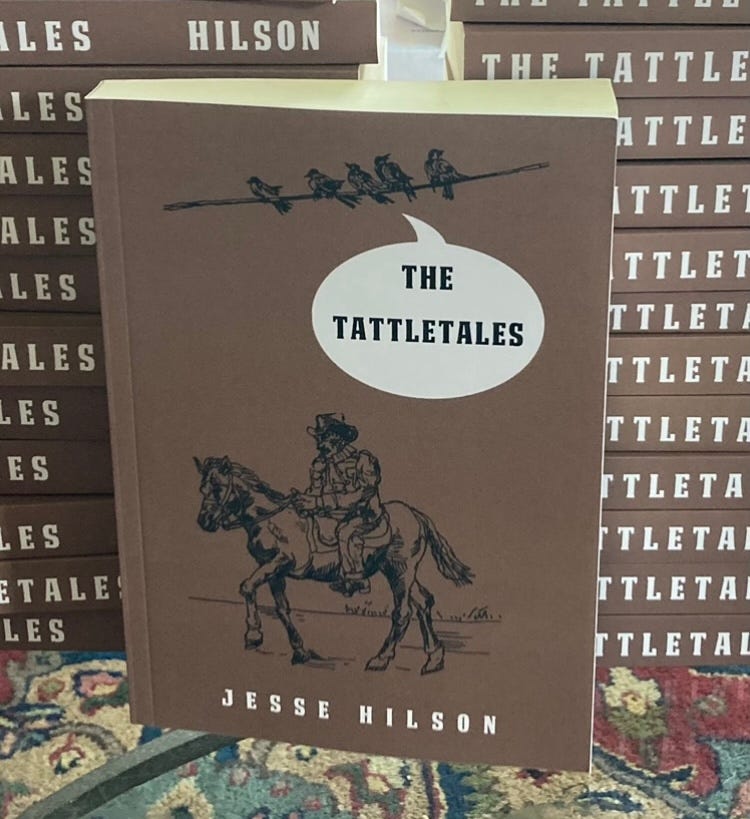
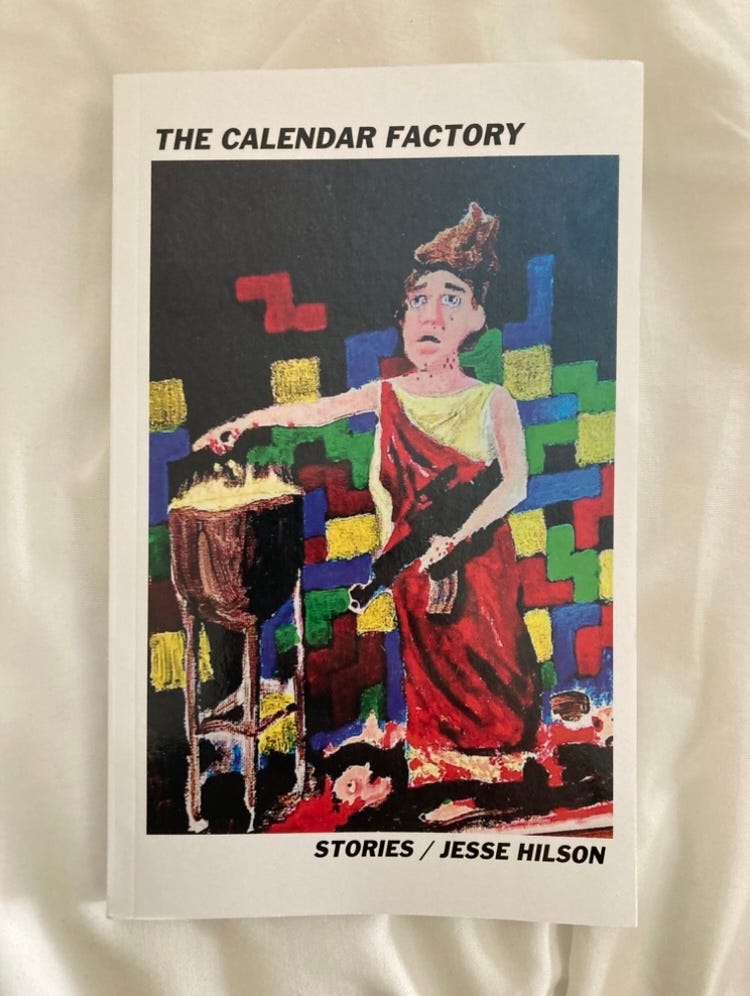
All available from Jeff Bezos’ lair but I may have a few copies of The Tattletales I can personally ship out to interested citizens of the USA; I know I have many copies of The Calendar Factory. Let me know in a DM on Substack if you might be curious to read these books. I’m particularly proud of The Tattletales. I call them Neo-Passéist self-consciously because I’m just playing it safe and in no way beyond this article have a pretense for being a Neo-Decadent of any standing. These books of mine are largely crime stories, genre pieces that would tire the Neo-Decadent leadership, although I’d like to think I tried to escape the clutches of genre and just write fun books.

//
Coming book reviews I want to write: Meat Puppets by Hannah Smart / Terrestrial by Suzy Eynon / Spare Us Yet by Lucas Smith (I’d like to read more of this new wave of Australian writers that are being talked about)
Currently reading: Lyric Poetry and Modern Politics: Russia, Poland, and the West by Clare Cavanagh / The Gutenberg Galaxy: The Making of Typographic Man by Marshall McLuhan
Currently listening to: Houston rap. Reading the Wikipedia pages on all the people connected with DJ Screw, all their fates and deaths, is chilling. Also listening to a lot of Janushoved cassette label. I keep saying I’ll write music reviews and that is still hopefully coming. I’m a mess of ambitions.